
Accounts Payable Automation is a digital-first workflow that leverages AI-driven data extraction and global e-invoicing standards to eliminate manual overhead in financial document management. In 2026, automation is no longer a luxury—it is a baseline requirement for ensuring data integrity, mitigating fraud, and optimizing operational costs. Finbite’s comprehensive solution reclaims a significant portion of the time previously lost to clerical tasks, transforming financial management into a strategic competitive advantage.
In this article:
- Why PDF Invoices are the Modern Corporate Bottleneck
- The 5 Hidden Risks of Manual Data Entry in 2026
- Comparison Matrix: Manual Entry vs. Finbite AP Automation
- ROI: Calculating the Financial Efficiency of AP Automation
- The Finbite Ecosystem: Data Recognition, Automated Workflows, and Digital Archive
- The Finbite Difference: Market-Leading Scalability
- Frequently Asked Questions (FAQ)
- Summary: Your Time is More Valuable Than Data Entry
Why PDF Invoices are the Modern Corporate Bottleneck
In today’s hyper-fast business environment, internal processes must move at the speed of light. Yet, many organizations remain tethered to the “PDF Era.” While a PDF arrives via email, it is functionally just a digital image of a paper document. Manually transcribing or “copy-pasting” these details into an ERP system is inefficient, high-risk, and demotivating for high-level finance talent.
When competitors leverage Finbite or similar automated ecosystems, they liberate capital and human resources that you are currently spending on basic data replication. This article examines why automation is your firm’s next major opportunity for efficiency scaling.
The 5 Hidden Risks of Manual Data Entry in 2026
1. Human Error and “Data Fatigue”
Even the most diligent AP specialists are prone to errors when processing hundreds of invoices monthly. A misplaced decimal, an incorrect vendor code, or a typo can lead to duplicate payments and significant tax compliance friction. Automation delivers up to 99% data accuracy.
2. The Surge in Sophisticated Invoice Fraud
By 2026, cybercriminals have mastered the art of intercepting PDFs via email to alter bank details. Machine-readable e-invoices, transmitted via encrypted channels (such as Peppol), are the only secure standard for modern B2B transactions.
3. Stagnant Cash Flow Forecasting
If invoices sit unprocessed in inboxes or physical trays, the CFO lacks a real-time view of liabilities. This latency leads to strategic decisions being made on outdated or incomplete data.
4. Talent Attrition
Modern accountants do not want to be “data entry clerks.” If you provide your team with routine manual tasks, they will migrate to firms that utilize cutting-edge tools like Finbite.
5. Zero Scalability
If your business volume doubles, do you need to double your accounting headcount? With an automated system, your capacity scales exponentially without a proportional increase in administrative overhead.
Comparison Matrix: Manual Entry vs. Finbite AP Automation
| Process Phase | Traditional Manual AP Management | Finbite Accounts Payable Automation |
| Data Entry | Manual entry from emails and PDFs | Instant AI-driven PDF extraction and e-invoice reception |
| Data Accuracy | Inconsistent; prone to human error | 99% accuracy; structured machine-readable data |
| Approval & Confirmation Flow | Via emails, on paper and based on verbal cues | Digital, automated, and real-time tracking |
| G/L Coding | Manual for every individual invoice | Automated for recurring vendors, invoices and patterns |
| Archive & Search | Manual folders/PDF servers (Time-intensive) | Searchable digital archive; instant retrieval based on machine readable data |
ROI: Calculating the Financial Efficiency of AP Automation
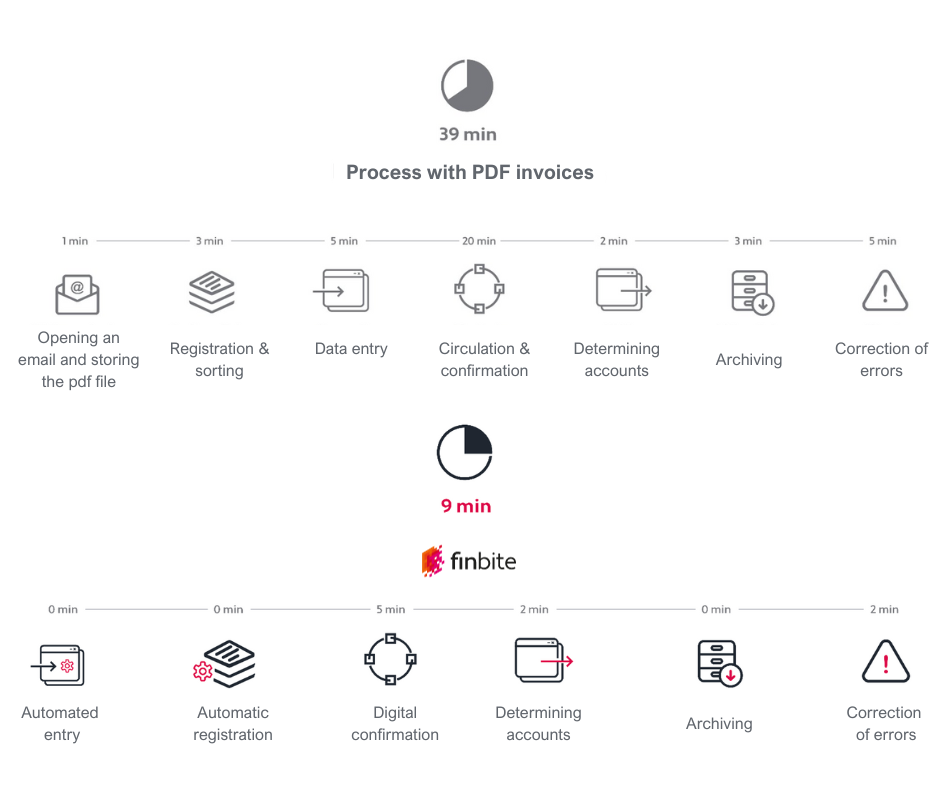
Our Smart AP Management Calculator quantifies exactly how many billable hours and currency units your team is currently losing without accounts payable automation tools. Example: A firm processing 300 invoices per month saves an average of €10,800 annually through automation.
How much would you save with digital purchase invoice management?
The Finbite Ecosystem: Data Recognition, Automated Workflows, and Digital Archive
Finbite is more than a invoice entry and data-reading tool; it is a holistic ecosystem covering the entire invoice lifecycle.
1. AI-Powered Smart Data Recognition
Since not all vendors have transitioned to e-invoicing, we bridge the gap with advanced PDF and receipt digitization. Our digitizing service is specifically for financial documents:
- Contextual Field Recognition: The system identifies vendors, dates, reference numbers, rows, and totals, learning to navigate even the most complex international invoice formats.
- Verification Needs: Because the AI operates with extreme precision, human intervention by Finbite digitizers is only required in exceptional cases. PDF invoices become machine-readable data streams entered into your ERP system.
2. Agile Approval Workflows
Once digitized, invoices move instantly into a customizeable approval and confirmation flow, ending the “lost email” era.
- Automated Routing Rules: Set parameters so invoices always reach the correct manager.
- Mobile Accessibility: Approvers receive mobile notifications and can authorize or reject payments with a single click while on the go, improving vendor relationships through on-time payments.
3. Compliant and Secure Digital Archiving
The final link in the chain is legal compliance. Most jurisdictions require 7-year document retention.
- Instant Search: Every invoice in the Finbite digital archive is searchable by vendor, number, or date range.
- Audit Readiness: Provide auditors with a complete digital “paper trail”—who sent the invoice, who digitized it, who approved it, and when it was settled. This is transparency at the highest level.
The Finbite Difference: Market-Leading Scalability
Finbite’s all-in-one environment focuses on three pillars: Speed, Simplicity, and Scalability.
- Core Competency in Data Accuracy: We ensure our PDF digitization remains the fastest and most accurate in the market.
- Seamless Implementation: We eliminate the friction of software transitions with ready-to-use integrations for all major ERP and accounting systems.
- Flexible Pricing: Our logic is adaptive—costs scale with your actual usage and the services you select, supporting both SMEs and Enterprise-level corporations.
Frequently Asked Questions (FAQ)
How does the AI extract data from PDFs?
Our solution “reads” invoices like a human does, identifying key headers and line items regardless of layout. Each document is verified to ensure data integrity before it reaches your ledger.
Can the approval workflow be customized for complex corporate structures?
Yes. You can create multi-stage approval flows, set up subs for holiday periods, and define specific spending limits for different users.
What is the implementation timeline for AP automation?
Standard integration with your existing ERP or accounting software typically takes moments. Our pre-built connectors ensure your daily operations continue without interruption.
How is the digital archive secure?
Digital storage is significantly more secure than physical folders or email servers, providing protection against both data leaks and physical data loss. You can control who has access to the documents and for how long, all actions are traceable back to the user.
Is this a step toward replacing accountants with AI?
On the contrary—it elevates the accountant’s role. Automation removes “robotic” clerical work, allowing finance professionals to focus on analysis, strategic planning, and advisory. The accountant becomes a Financial Technologist and a strategic partner to the board.
Summary: Your Time is More Valuable Than Data Entry
In the 2026 economic landscape, the winners are not those who work the hardest, but those who work the smartest. AP automation is the most logical step on the path to digital efficiency.
Are you ready to eliminate manual overhead and elevate your financial management?